Tool Selection Guide for Weld Neck Flange Maintenance
Piping maintenance during turnarounds and routine servicing depends on three practical factors: flange face geometry, initial access clearance, and line stiffness.
Improvised methods like hammers, chisels, or pry bars cause serious safety hazards. Forcing makeshift tools into the gap damages precision sealing faces, which leads to joint leaks, costly rework, and plant downtime.
The guide below outlines the correct MATCH mechanical and hydraulic tools for common weld neck flange configurations.
Tool Selection by Joint Clearance
Flanges with Access Clearance: Raised Face, RTJ, and API 6B
When flange face geometry or gasket thickness provides an accessible opening, wedge spreaders deliver controlled, non-destructive separation.
-
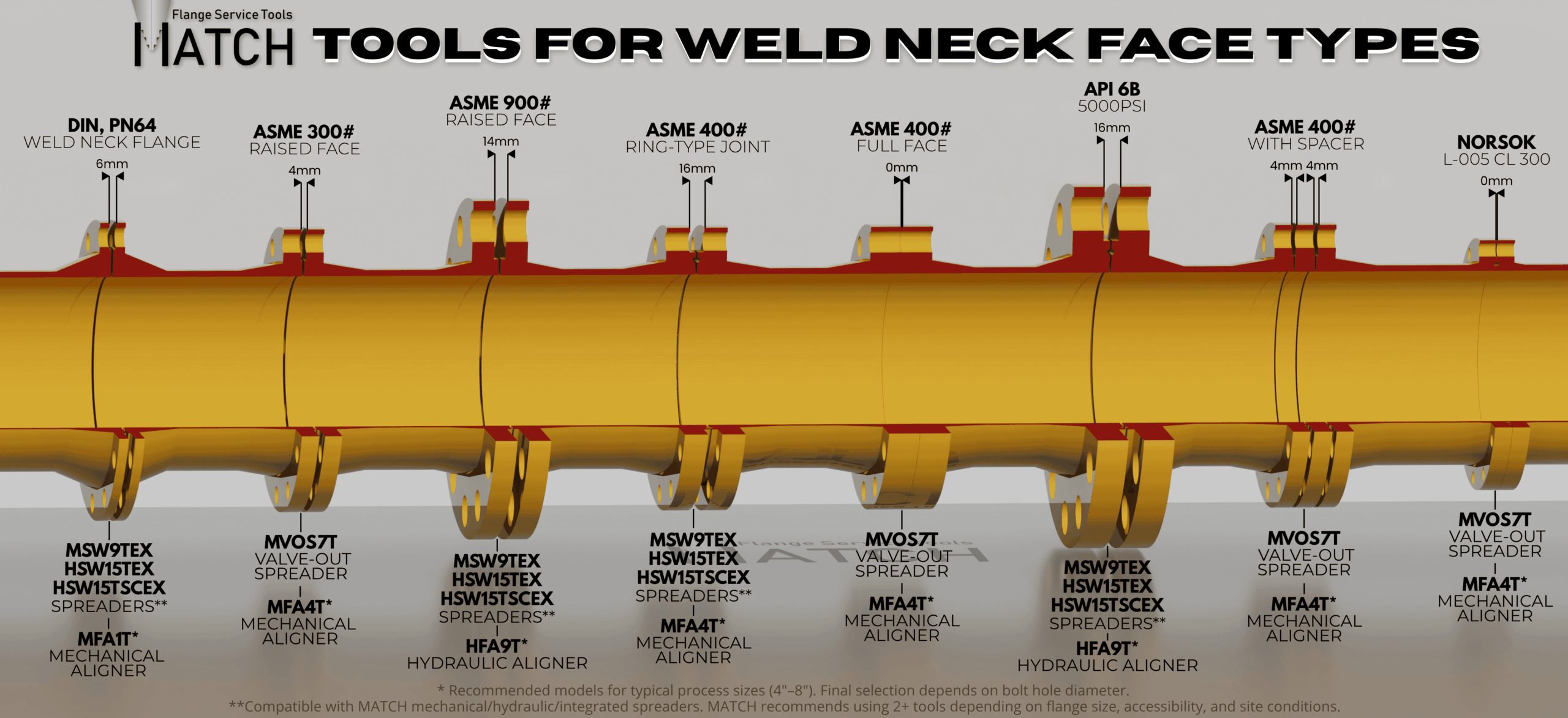
DIN, PN64 Weld Neck (6 mm gap)
Mechanical and hydraulic wedge spreaders (MSW9TEX, HSW15TEX, or HSW15TSCEX) fit this gap directly. Bolt hole realignment is handled with the MFA1T mechanical aligner.
-
ASME 900# Raised Face (14 mm gap)
Heavy-wall, high-pressure lines require significant spreading force. Use the MSW9TEX mechanical spreader, or hydraulic HSW15TEX and HSW15TSCEX spreaders. Bolt hole realignment requires the HFA9T hydraulic aligner.
-
ASME 400# Ring-Type Joint / RTJ (16 mm gap)
RTJ profiles require clean axial separation to clear the metallic ring without scraping the grooves. Recommended spreaders include MSW9TEX, HSW15TEX, or HSW15TSCEX, paired with the MFA4T mechanical aligner.
-
API 6B 5000 PSI (16 mm gap)
Standard in upstream and high-pressure drilling manifolds. Heavy pipe stiffness requires hydraulic power: HSW15TEX or HSW15TSCEX wedge spreaders, combined with the heavy-duty HFA9T hydraulic aligner.
Zero Clearance and Restricted Joints: Full Face, Spacers, and Compact Flanges
Standard wedge spreaders require an opening to insert the step tips. Forcing a wedge into zero-clearance or delicate joints damages the gasket seating surface. Valve-out spreaders bypass this issue by anchoring through the bolt holes instead.
-
ASME 400# Full Face (0 mm gap)
Full-face contact leaves no perimeter gap for standard wedges. The MATCH MVOS7T valve-out spreader bolts directly into the flange holes to separate the joint safely from the outside. Hole alignment uses the MFA4T mechanical aligner.
-
NORSOK L-005 CL 300 Compact Flange (0 mm gap)
Compact flanges seal metal-to-metal and cannot tolerate face gouging. Separation is handled by the MVOS7T valve-out spreader, paired with the MFA4T mechanical aligner.
-
ASME 400# with Spacer (4 mm + 4 mm gap)
Replacing or servicing spade blinds, spacers, or orifice plates requires expanding the joint linearly so the insert slips out freely. The MVOS7T valve-out spreader delivers parallel axial movement without binding, with alignment handled by the MFA4T.
-
ASME 300# Raised Face (4 mm gap)
For tight clearance setups or specific valve changeouts, the MVOS7T provides safe, controlled opening, combined with the MFA4T mechanical aligner.
MATCH Tool Compatibility Matrix
| Flange Profile | Access Gap | Recommended Spreader | Recommended Aligner |
|
DIN, PN64 Weld Neck
|
6 mm |
||
|
ASME 300# Raised Face
|
4 mm |
||
|
ASME 900# Raised Face
|
14 mm |
||
|
ASME 400# Ring-Type Joint (RTJ)
|
16 mm |
||
|
ASME 400# Full Face
|
0 mm |
||
|
API 6B 5000 PSI
|
16 mm |
||
|
ASME 400# with Spacer
|
4 mm + 4 mm |
||
|
NORSOK L-005 CL 300
|
0 mm |
Aligner models (MFA1T, MFA4T, HFA9T) are recommended for typical process sizes (4 to 8 inches). Final selection depends on bolt hole diameter and pipe size.
Any MATCH flange spreader mechanical/hydraulic/integrated can be used depending on site preference, accessibility, and joint requirements. MATCH recommends using 2 or more tools in tandem based on flange diameter and stiffness.